
Home drainage guide · published September 15, 2026
Can your driveway send rainwater into the basement?
Sometimes the first clue is indoors: a damp smell, a stripe of mold behind drywall, or a foundation crack that darkens whenever it rains. But the story may begin outside, where an asphalt driveway quietly collects roof and surface runoff and delivers it to the house. Water takes the cheapest ticket downhill. Your job is to find out whether the driveway sold it one.
Jump to the rainy-day check ↓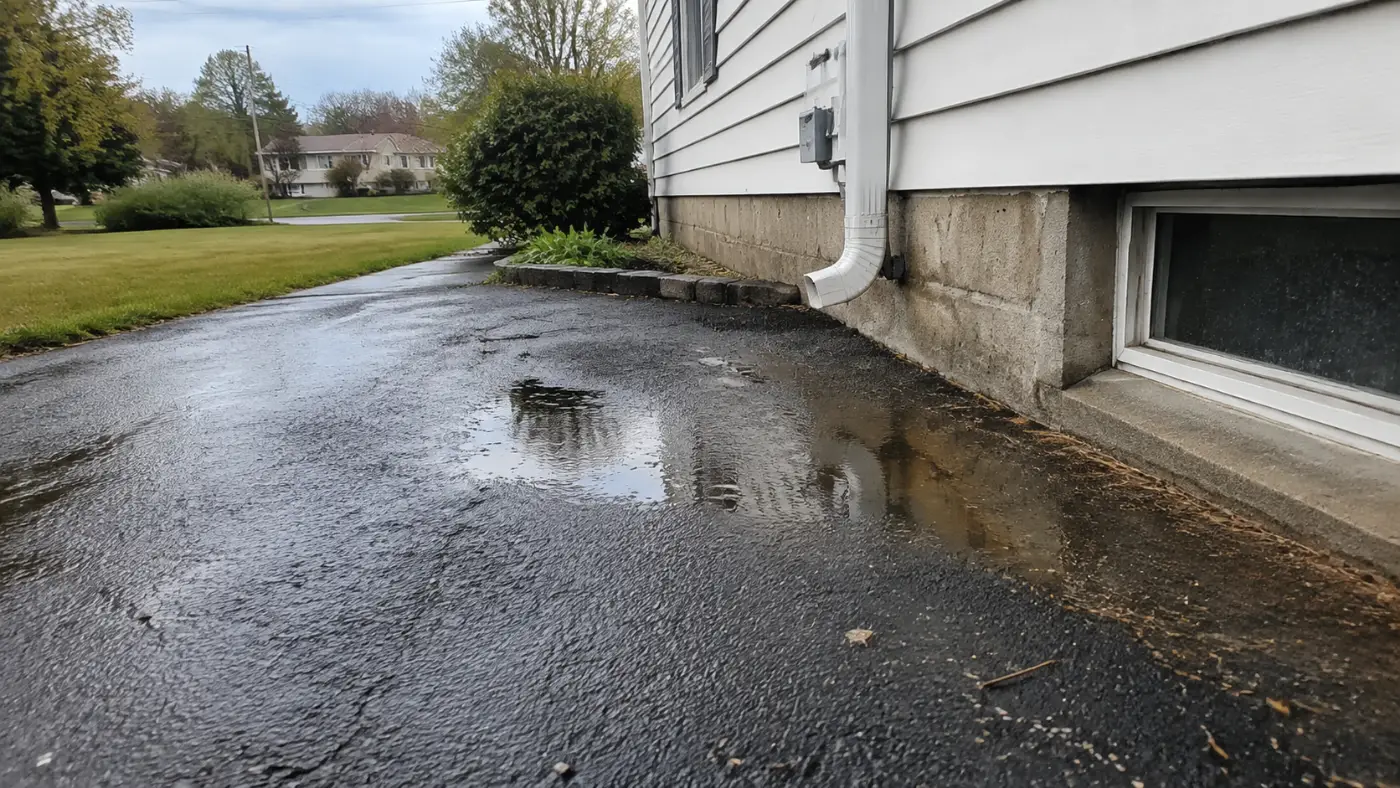
The basement leak that started outdoors
Imagine opening the wall of a 1980s basement after finding mold. Behind the drywall is damp fiberglass, old asphalt felt against the concrete, and a small foundation crack. Someone had cut the felt years earlier, which suggests the stain is not a new guest. The tempting question is, “What should replace the missing felt?” The more valuable question is, “Why did rainwater keep arriving here?”
Indoor materials matter, but they are downstream. If a driveway, patio, roof valley, or downspout keeps loading the soil beside the wall, a neat interior patch may only hide the next wetting event. Building Science guidance treats foundation bulk-water control as a prerequisite for basement insulation and finishing. In plain English: stop feeding the wall before redecorating it.
This is a possible route, not a diagnosis. Groundwater, a failed footing drain, a window well, a plumbing leak, or another surface can create similar symptoms.
How an asphalt driveway becomes part of the problem
Asphalt is nearly impervious compared with lawn. That is useful when the pavement is pitched toward a safe outlet; it becomes troublesome when the finished surface aims at the house. Three mechanisms show up again and again.
- Negative pitch or settlement. A driveway may have been paved toward the house from day one, or a utility trench, weak base, and repeated traffic may have created a saucer-shaped low spot later.
- Concentrated roof runoff. A downspout can turn one section of driveway into a tiny river. The pavement is not creating the rain, but it may transport that concentrated discharge straight to the foundation joint or garage wall.
- A blocked escape route. Raised edging, leaves in a channel drain, a heaved sidewalk, or a new overlay can trap water that once crossed the property safely. Even a shallow lip can change where a puddle forms.
Surface water accumulating at the foundation can saturate nearby soil. Building Science notes that this accumulation can create hydrostatic pressure that pushes water through available cracks, joints, and imperfections. The driveway does not have to touch the crack to influence how much water reaches it.
The 2% driveway slope benchmark, translated
DOE's Building America Solution Center summarizes a common U.S. model-code benchmark: impervious surfaces within 10 feet of a foundation slope at least 2% away from the building. Two percent means 2 units of fall for every 100 units of horizontal run—about 1/4 inch per foot. Across 10 feet, that is roughly 2.4 inches of fall.
This number is a screening tool, not permission to order a truck. An older driveway may have too little clearance below the siding or garage threshold to add asphalt. A steep cross-slope can create accessibility or winter-safety problems. Local codes and stormwater rules decide where runoff may discharge. A drainage professional or paving contractor must reconcile all of those elevations on site.
Do the rainy-day driveway check before calling it a basement problem
The most honest inspection happens during steady rain or immediately afterward. Stay clear of lightning, slippery slopes, moving vehicles, and active flooding. Do not manufacture a flood with a hose against the foundation. Observe what the weather already reveals, then photograph the same locations from wide and close views.
- Start at the roof: where do gutters overflow, and where does each downspout end?
- Watch leaves or tiny bubbles on the pavement to see the actual direction of shallow flow.
- Mark puddle edges with chalk and note how long they remain after the rain stops.
- Look for settlement at the garage apron, foundation edge, utility cuts, patches, and channel drains.
- Compare the outside wet area with the location and timing of the indoor stain.
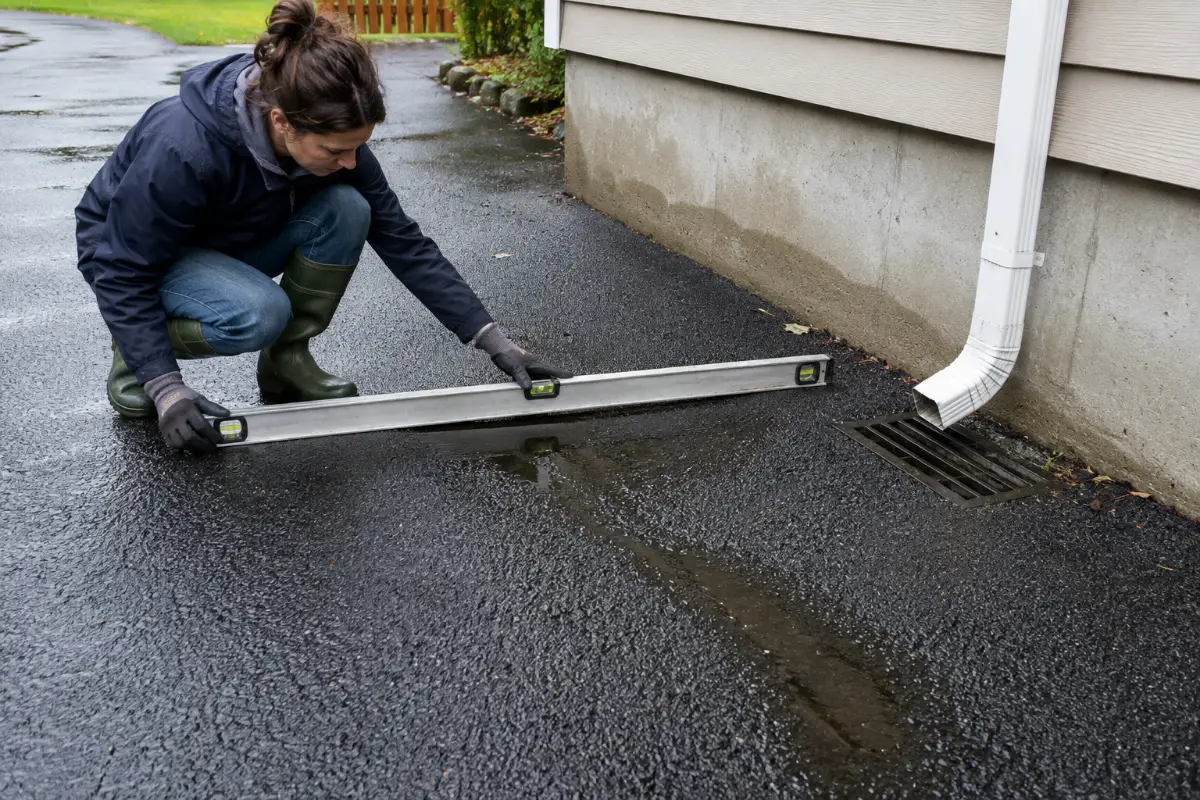
- Use a straightedge plus a level, or a calibrated digital level, to measure several paths—not one lucky spot.
Match the drainage fix to the broken link
A black bucket of coating is not a drainage plan. The right repair depends on where the route fails and where the captured water can legally and safely go.
Swipe sideways to compare all columns.
| Observed clue | Likely next move | What it does not solve |
|---|---|---|
| Downspout empties at the wall | Route it to an approved outlet away from the foundation | A settled driveway bowl or failed underground drain |
| Small isolated low spot | Evaluate base support and a full-depth local correction | A driveway-wide reverse slope |
| Runoff crosses toward the house | Compare regrading with an intercepting channel drain | An active structural crack or groundwater pressure |
| Water remains after surface fixes | Investigate foundation, window well, footing drain, sump, and plumbing | Nothing—escalate beyond pavement |
A channel drain is not a decorative grate. It needs enough width and capacity for the contributing area, a maintainable outlet, proper bedding, and an elevation that intercepts water before the wall. Repaving is not automatically better: an overlay that follows the old surface can preserve the same reverse pitch—or raise the pavement dangerously close to siding and door thresholds.
What new asphalt can—and cannot—fix
A properly designed reconstruction can change finished elevations, remove unstable material, rebuild the base, and create a reliable route to a drain or safe discharge point. A thin surface treatment cannot. If the low area keeps returning, the base or subgrade may be moving; hiding it beneath fresh black material buys appearance, not drainage.
Plan quantity only after the drainage geometry is settled. Our asphalt calculator estimates area, volume, tonnage, coverage, and an early material-cost range from the dimensions and compacted thickness you enter. It does not size drains, establish grade, check thresholds, design a pavement section, or estimate foundation waterproofing.
The right order
Design the water path, then calculate the asphalt
Ask the contractor to show proposed high points, low points, compacted lifts, drainage structures, and the outlet on the written scope. Then measure the actual paving area and depth.
Estimate asphalt tonnage →Do not let the indoor repair erase the outdoor evidence
If moldy drywall or insulation has been removed, leave the area accessible long enough to confirm that it stays dry through real rain. EPA guidance says to fix the water problem and dry wet or damp materials within 24–48 hours to reduce mold-growth risk. The agency also advises making sure ground slopes away from the foundation and keeping roof gutters in working order.
This does not mean every basement needs excavation, rigid foam, or a new driveway. It means the sequence matters: control roof and surface water, inspect visible openings, remove damaged moisture-sensitive materials, dry the assembly, choose a climate- and code-appropriate wall repair, and monitor humidity and rain events. Large mold areas, recurring seepage, structural movement, electrical hazards, sewage, or uncertain drainage outlets belong with qualified local professionals.
Driveway slope and basement water FAQ
Can a driveway really cause water in a basement?
Yes. A driveway that slopes toward the house, holds a low spot beside the foundation, or receives concentrated roof runoff can increase the amount of water reaching foundation soil and openings. That makes the driveway a possible contributor, not automatic proof of the leak's only cause; cracks, footing drains, groundwater, window wells, and plumbing should also be checked.
What driveway slope should carry water away from a house?
A 2% slope away from the foundation is a useful U.S. model-code benchmark for nearby impervious surfaces: about 1/4 inch of fall per horizontal foot. Treat it as a diagnostic reference, not a universal retrofit specification. Existing elevations, garage thresholds, accessibility, local code, and the legal discharge point must be evaluated on site.
Will sealcoating stop driveway water from reaching a basement?
No. Sealcoat is a surface-maintenance treatment; it does not reverse a bad slope, lift a settled low spot, create a drainage outlet, repair a foundation crack, or restore a failed footing drain. It may make the asphalt look more uniform while the same water path remains underneath the problem.
Should I install a channel drain or repave the driveway?
A channel drain can intercept runoff where regrading is constrained, but it needs the right capacity, placement, maintenance access, and a lawful outlet. Repaving can correct pitch only when the crew designs the finished elevations and has room for adequate asphalt and base thickness. A contractor should survey the water path before choosing either option.
Sources and evidence boundaries
This article applies public building-science guidance to a common residential driveway scenario. It cannot identify a leak source from a photo or replace local code, drainage design, mold assessment, structural evaluation, or a site visit. The generated illustrations show clues to inspect; they are not construction drawings.
- DOE Building America Solution Center: Final Grade Slopes Away from Foundation — slope benchmarks, hard-surface drainage, swales, drains, and site-grading context.
- Building Science Corporation: Bulk Water Control Methods for Foundations — roof runoff, surface water, soil loading, foundation openings, and retrofit sequencing.
- U.S. EPA: A Brief Guide to Mold, Moisture and Your Home — moisture-source correction, prompt drying, gutters, and grade around the foundation.
Related posts and tools